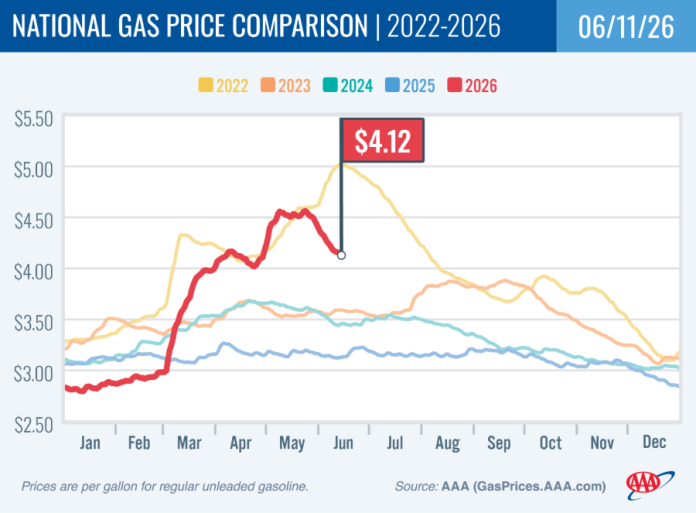
As summer heats up, small business owners are seeing a welcome dip in gasoline prices after three consecutive weeks of decline. The national average for a gallon of regular gas has fallen from $4.56 on May 21 to $4.12, instilling a sense of relief during a season typically marked by peak fuel costs.
Crude oil prices remain below the $100 per barrel mark, significantly impacting the affordability of fuel around the nation. While pump prices are still at a four-year high, they are substantially lower than the record-breaking average of $5 per gallon set in June 2022.
Today’s national average stands at $4.129, a decrease from last week’s average of $4.241 and a sharp decrease from $4.520 just one month ago. A year ago, drivers were paying an average of $3.125, highlighting the current economic pressures.
For small businesses reliant on transportation, this drop in fuel prices translates into tangible savings. Companies involved in logistics, delivery services, or any business that relies on vehicle travel could see improved profit margins as their operational costs decrease. Easing fuel expenses helps businesses allocate funds to other vital areas, such as marketing or staff bonuses.
According to the Energy Information Administration (EIA), gasoline demand surged last week, climbing to 8.73 million barrels per day from 8.59 million. Domestic supply also saw a slight uptick, inching up to 215.1 million barrels. The increase in gasoline production averaging 9.7 million barrels per day suggests a growing market and could stabilize prices even further if this trend continues.
These dynamics are being closely observed, especially given the unpredictable nature of oil markets. Factors such as the ongoing geopolitical tensions in the Strait of Hormuz introduce uncertainty, which could lead to volatility in fuel prices moving forward.
In addition to gasoline, there’s been a slight increase in electricity costs at public EV charging stations, which rose by one cent to 42 cents per kilowatt-hour. Although this increment is minimal, businesses considering transitioning to electric fleets may want to account for these operational costs when planning their budgets. Regions vary widely in terms of EV charging costs, with the most expensive states, such as West Virginia and Hawaii, charging rates of 52 and 51 cents, respectively. Conversely, businesses in states like Kansas and Missouri benefit from significantly lower rates at 30 and 32 cents per kilowatt-hour, making them more attractive for electric vehicle adoption.
For those contemplating how these market shifts may affect their operations, understanding regional price variances becomes crucial. In states like California and Hawaii, gasoline prices remain notably high, with averages of $5.80 and $5.58, respectively. In stark contrast, Indiana enjoys the lowest gasoline prices at $3.39, followed by Texas and Oklahoma at $3.58 and $3.61, respectively.
As summer travel ramps up and fuel demand grows, the potential for further increases in gasoline prices remains. Small business owners, particularly those with operations in states with high fuel costs, should consider strategies for efficiencies, such as route optimization or evaluating alternatives to traditional gasoline vehicles.
In addition to monitoring fuel prices, small business owners can leverage resources such as the AAA TripTik Travel Planner to find current gas and electric charging prices along their travel routes. This valuable tool can aid in budgeting and planning for travel expenses, enabling businesses to better manage their bottom lines.
As the market continues to evolve, staying informed about gas prices and anticipating future trends will be essential for small businesses to navigate these changes effectively. For more detailed information, you can access the original press release here.
Image Via Gas Price