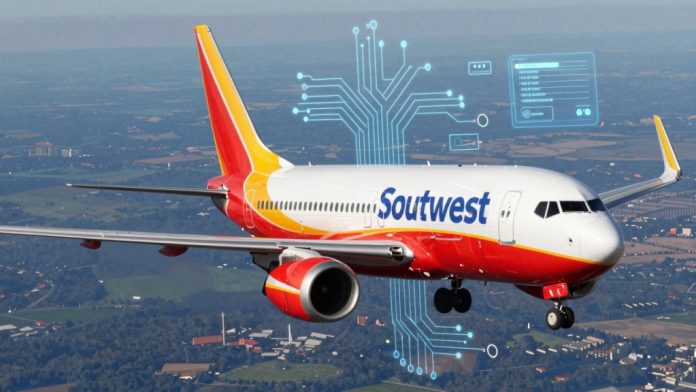
Southwest Airlines is embarking on an ambitious journey to modernize its technological infrastructure, partnering with Amazon Web Services (AWS) to transition to a fully cloud-based environment by 2028. The move aims to enhance operational flexibility, improve customer experience, and establish a more efficient technology foundation.
As a pivotal shift in strategy, this partnership signals a growing trend among businesses, including small enterprises, to leverage cloud technology and artificial intelligence (AI) for competitive advantage. In an increasingly digital marketplace, the integration of cloud solutions can provide small business owners with tools for rapid scalability and better operational efficiency.
Lauren Woods, Executive Vice President & Chief Information Officer at Southwest Airlines, emphasized the airline’s commitment to performance and reliability. “Southwest has always evolved our business with a focus on improving performance, efficiency, and reliability—and applying that same mindset to our technology with AWS is a core part of that strategy,” she said. This focus on modernization can resonate with small business owners looking to keep pace with technological advancements.
The complexity in traditional business environments often hinders agility, which is essential for adapting to market demands. By moving to a cloud system, Southwest aims to streamline operations that currently depend on a variety of onsite systems, potentially applicable to smaller businesses that may also rely on outdated software.
One of the key technologies being employed in this transition is Kiro, AWS’s agentic coding service. This platform will facilitate the modernization of Southwest’s consumer-facing site, Southwest.com, by refactoring legacy code. This could serve as a blueprint for small businesses looking to improve their digital presence without the lengthy timelines usually associated with software upgrades. By leveraging tools like Kiro, organizations can see significant reductions in development time for features that serve customers directly.
The airline is also implementing an AI-Driven Development Lifecycle (AIDLC). This intelligent software development workflow integrates AI capabilities to assist teams in speeding up the development process. “By deploying AI agents across customer experience, operations, and software development, they’re accelerating innovation for 134 million travelers,” noted Swami Sivasubramanian, Vice President, Agentic AI at AWS. Adoption of AI in smaller businesses can yield similar efficiencies by automating repetitive tasks, thus allowing teams to focus on strategic initiatives.
However, transitioning to a cloud-based architecture does present some challenges. Cost considerations are paramount; small business owners must assess whether the initial investment in cloud services and AI technologies aligns with their long-term growth strategies. Not all small businesses have the same financial resources as larger corporations, and therefore the scalability of such solutions should be evaluated carefully.
Another concern may be the training and upskilling of employees to effectively utilize these new technologies. An investment in training can ensure that staff are well-equipped to maximize the benefits of the cloud and AI capabilities, minimizing disruptions during the transition. Small businesses often operate with limited personnel, making it essential to have a clear plan for integrating new systems without overwhelming the team.
The partnership between Southwest Airlines and AWS exemplifies how adaptation to technological advancements can open new avenues for operational efficiency and customer engagement. By choosing to modernize its technology stack, Southwest is not only enhancing its internal operations but is setting a compelling example for other businesses. The implications for small business owners are clear: embracing cloud technology and AI can lead to scalable solutions that drive efficiency and improve customer interactions.
While the path to modernization may have its hurdles, the benefits are undeniable. Small business owners can look to this example as a reason to explore how cloud-based solutions in their operations may yield substantial dividends in the long run. More detailed information about Southwest’s initiative can be found in the original press release here.
Image Via BizSugar